

How to Mix Patterns in Home Decor Like a Pro: The Complete Guide
Pattern mixing is one of the most powerful tools in interior design, and also one of the most intimidating. Done well, it creates rooms that feel layered, lived-in, and full of character. Done poorly, it produces visual noise. The difference comes down to a few repeatable principles that professional designers rely on every day.
This guide breaks down those principles so you can apply them with confidence in any room of your home.
Understand the Three Pattern Categories
Most decorative patterns fall into three broad families: geometric (stripes, chevrons, grids, diamonds), organic (florals, botanicals, abstract shapes, paisleys), and textural (woven patterns, tone-on-tone damasks, subtle jacquards). A well-mixed room typically draws from at least two of these categories. Pulling patterns exclusively from one family creates monotony. Pulling from all three creates richness.
Vary the Scale
Scale is the single most important variable in pattern mixing. Every successful combination includes at least two different scales: one large, one small. A large-scale floral paired with a small-scale geometric stripe creates visual contrast without conflict. Two patterns at the same scale will compete for attention and make a space feel chaotic. When in doubt, go bigger on your anchor piece (sofa, duvet cover, area rug) and smaller on your accent pieces (throw pillows, napkins, lampshades).
Anchor Everything With a Color Thread
The fastest way to make mismatched patterns feel intentional is shared color. Pick two or three colors that repeat across your patterned pieces. They do not need to be identical shades; tonal variation actually strengthens the effect. A navy stripe, a cobalt floral, and a dusty blue geometric will read as cohesive because the eye connects the blue thread running through all three.
Use Solids as Breathing Room
Solids are not the absence of design. They are the negative space that lets your patterns sing. A room where every surface carries a pattern will exhaust the eye. Strategic placement of solid-colored furniture, walls, or textiles gives visual rest between patterned elements. A good ratio to start with: roughly 60 percent solid surfaces, 40 percent patterned. Adjust from there based on your personal tolerance for visual stimulation.
Start With What You Already Own
You do not need to start from scratch. Look at the patterns already in your space: your rug, your curtains, your existing pillows. Identify the dominant colors and the scale of each pattern. Then fill the gaps. If your rug is a large-scale organic pattern, your throw pillows might introduce a small-scale geometric in a complementary color. Build outward from what exists rather than replacing everything at once.
The One Rule You Can Always Break
Every design guide includes a rule about not mixing more than three patterns. Ignore it. Professional maximalist designers routinely layer five, six, or seven patterns in a single space. The principles above (scale variation, color threading, solid breathing room) are what create harmony, not an arbitrary pattern count. If the fundamentals are right, more patterns simply means more personality.
Common Mistakes to Avoid
Matching everything too closely is as much a mistake as matching nothing at all. A room where the curtains, pillows, and bedding all come from the same coordinated collection looks assembled, not designed. The goal is collected: pieces that look like they found each other over time, connected by subtle relationships in color and scale rather than by a shared SKU number.
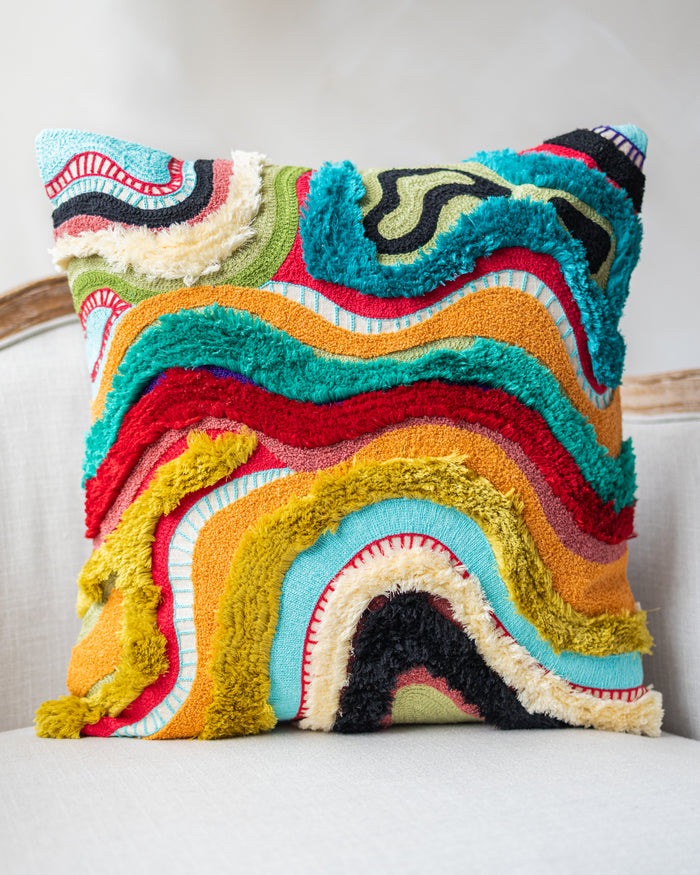
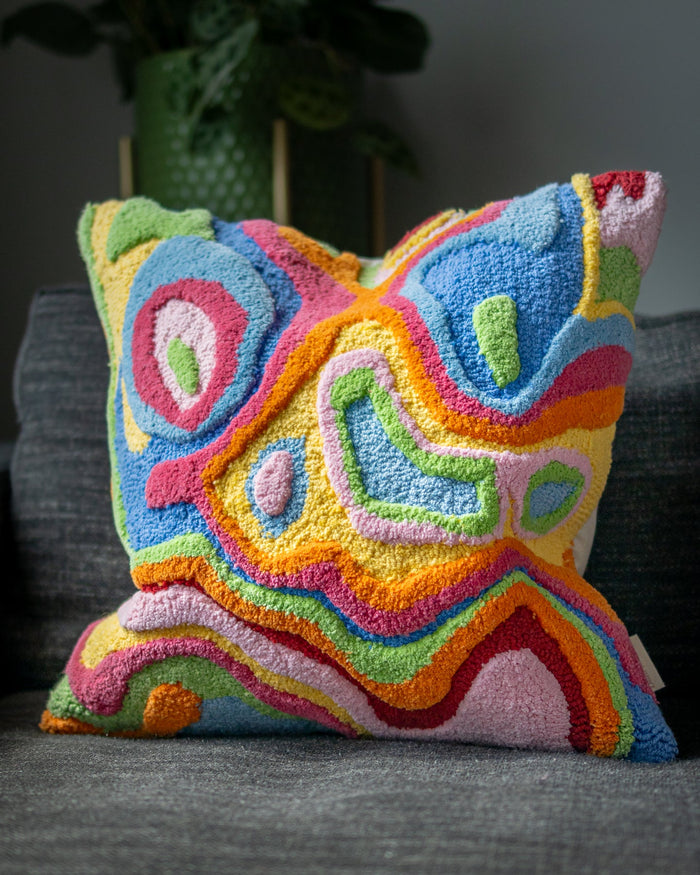
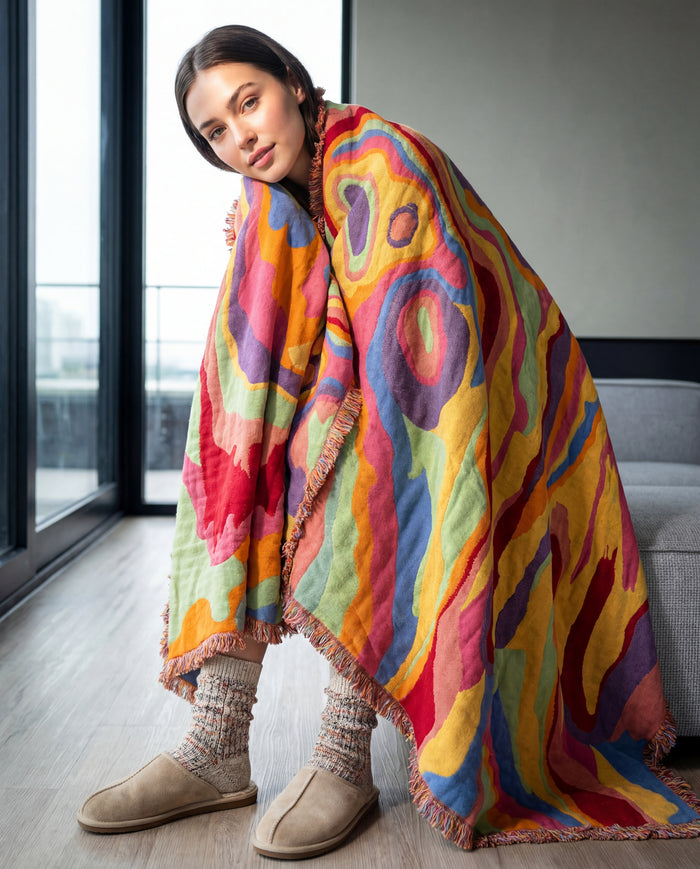
At YaYa & Co., our collections are designed with mixing in mind. Our abstract prints, organic patterns, and textured weaves share color DNA that makes them natural companions, while their individual character ensures your space looks uniquely yours. Explore our full pillow and throw collection to find your next pattern layer.


Dopamine Decor
Color you can put down and take with you
Hand-tufted abstract rugs, embroidered throw pillows and tapestry blankets in organic cotton and wool.
Shop dopamine decor