


Organic Dopamine Decor: Where Bright Color Comes From
If you have spent any time reading labels on what goes into your house, colorful decor is where it gets complicated. Most of what is sold as bright home textiles is polyester, printed rather than dyed, and finished with something to make the print hold. That is how it gets to be inexpensive.
We have had this conversation with enough customers to know it comes up, so here is the honest version.
Bright color is hard on natural fibers
Cotton and wool do not take strong color easily. Cotton in particular has to be prepared before dye will bond to it properly, and the deep saturated shades take more of everything: more dye, more water, more time. Synthetic fibers accept color far more readily, which is a real reason so much bright decor is made from them.
So a brightly colored organic cotton rug costs more than a brightly colored polyester one for reasons that have nothing to do with branding.
What natural dye can and cannot do
Plant and mineral dyes produce a specific set of colors beautifully. Indigo, madder red, weld yellow, walnut brown, the ochres. Those have been made this way for centuries and they age well, shifting rather than fading flat.
They do not produce hot pink, electric cobalt or acid lime. Anyone telling you a fully naturally dyed textile is available in every color of a modern abstract is selling you something. We wrote about the process itself in natural dyes.
Which leaves a real choice for anyone making colorful textiles: stay inside the natural palette, or use tested low-impact dyes and be straight about it.
What we do and what we will not claim
Our fibers are organic cotton and wool. The dyes are tested against OEKO-TEX limits for harmful substances, which is a standard about what ends up in the finished cloth and on your skin, verifiable by certificate rather than by us saying so.
That is not the same claim as fully natural dye, and we are not going to make that claim across a catalog that includes bubblegum pink and periwinkle. The pieces sitting in the natural palette are what they are, and the brighter pieces are dyed to a tested standard. Both are on organic base cloth.

Look at the pouf, because it is the clearest case
A pouf is a good test of whether a company means it, because the fill is the part nobody sees and the easiest place to cut a corner. Most of them are stuffed with polystyrene beads or shredded foam offcuts, which is fine functionally and is landfill at the end.
Ours has an organic cotton shell and a fill of organic pine shavings. The whole object is biodegradable. It weighs around thirty pounds, which is what keeps it in place under someone's heels, and it takes a hundred and fifty pounds of weight. The cover unzips and goes in the machine.
It costs more than a bead-filled pouf and it exists because the alternative was making a beautiful thing with a bag of plastic inside it.
Shop this look

Why hand-tufted matters here
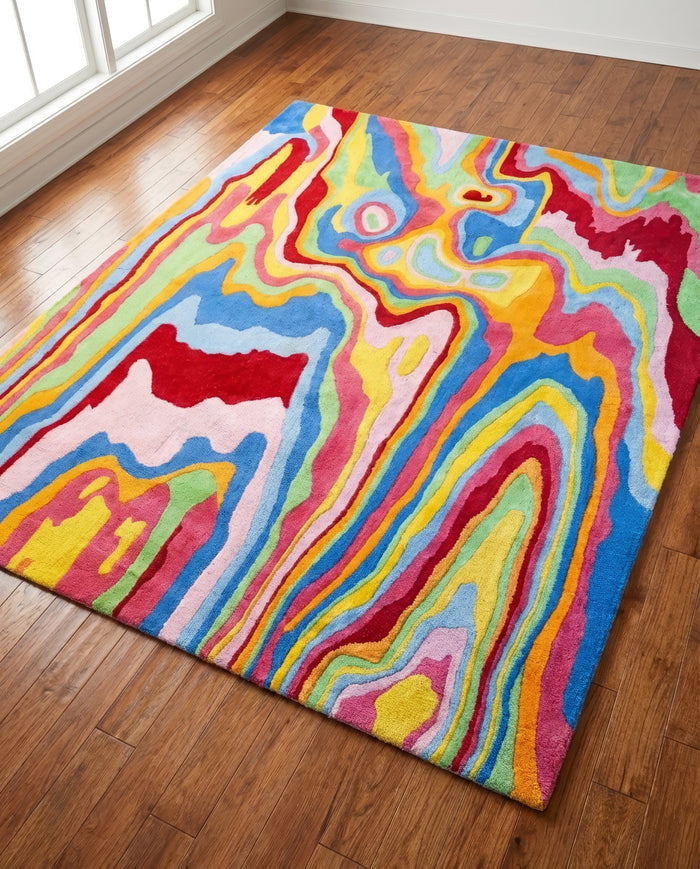
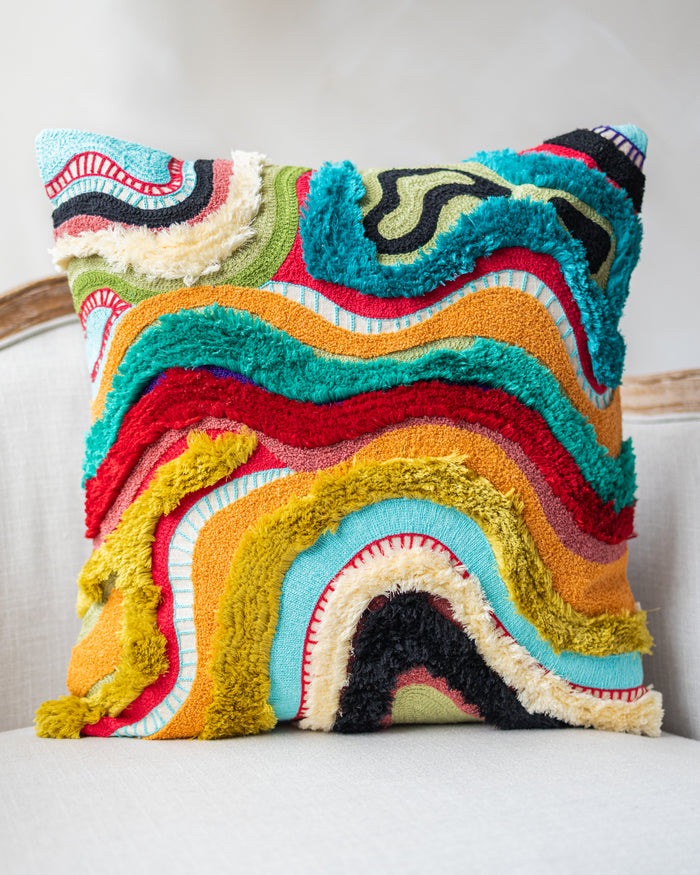
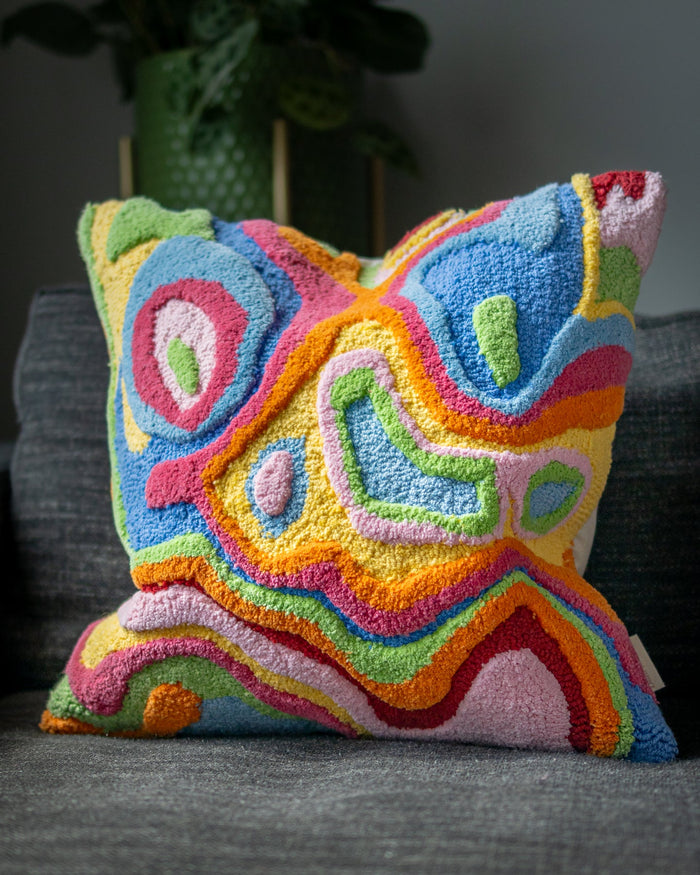
Our rugs, embroidery and beading are done by hand by partners in India we have worked with for years. Hand work uses a fraction of the energy of machine production and it is why the abstracts vary slightly from one piece to the next.
It also changes what happens at the end. A hand-tufted wool rug on a cotton backing can be repaired, and at the end of its life it is a natural fiber object. A printed polyester rug is not repairable and does not go anywhere good.
The trade-off is shedding. A new tufted rug drops loose fiber for the first three to six months. Vacuum in one direction with suction only and it settles. That is a property of the construction, and a rug that never sheds is usually one that was made by a machine out of something else.
What to look for when you are not buying from us
Fiber content first, before any certification logo. If the composition line says polyester or polypropylene, everything else is decoration on that fact.
Then ask whether the color is dyed or printed. Printed means the color sits on the surface and will wear at the fold and the traffic line. Dyed goes through the fiber.
OEKO-TEX Standard 100 tells you about harmful substances in the finished textile. GOTS tells you about organic content and the processing chain. Neither one means naturally dyed, and a lot of copy online implies that they do.
For a rug specifically, ask what the backing is. A cotton backing is a natural-fiber object all the way through. A latex or synthetic backing on an otherwise organic rug is the part that decides how it ends.
The collaboration question
When we worked with Dani Klarić on the Bellows and star patterns, the constraint we gave her was the material rather than the palette. She could have whatever colors the painting needed, on organic cotton and wool, dyed to the same standard as everything else we make.
That is a harder brief than it sounds, because the easy version of a bright designer collaboration is to print the artwork onto whatever accepts it fastest. Hand-tufting a painting into a rug takes months and the color has to be matched in yarn rather than ink.

The longevity argument
The most sustainable colorful thing in your house is the one you still like in eight years. That is partly materials and mostly taste, which is the whole case for choosing color you actually respond to rather than color that was trending.
A hand-tufted wool rug lasts decades with normal care. A cheap bright rug lasts two or three years and then goes in a dumpster, and whatever you saved buying it goes with it.
Everything in dopamine decor is organic cotton or wool. The full material story runs through organic cotton and ethical wool.


Dopamine Decor
Color you can put down and take with you
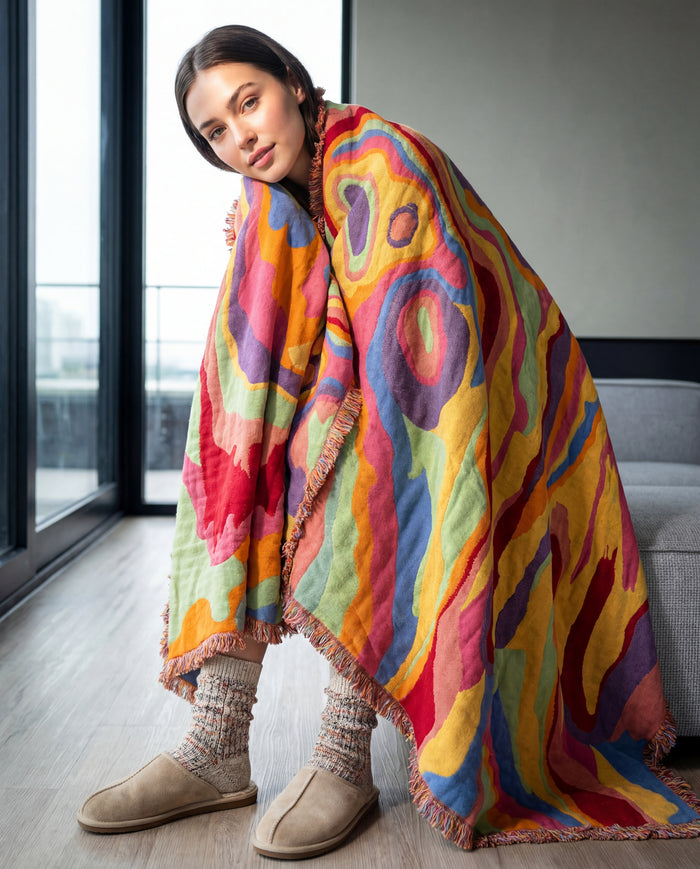
Hand-tufted abstract rugs, embroidered throw pillows and tapestry blankets in organic cotton and wool.
Shop dopamine decor